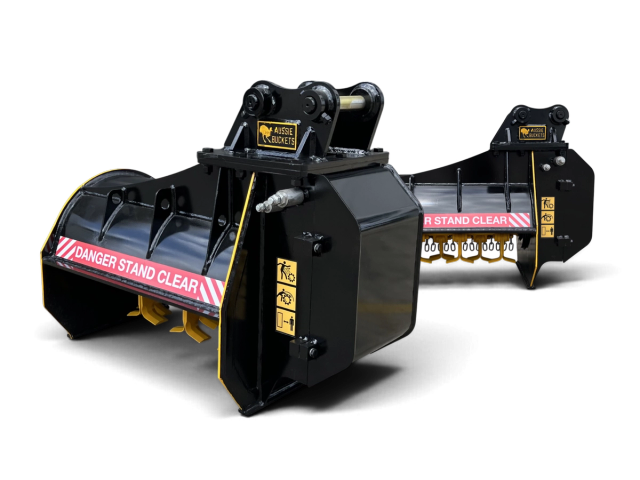
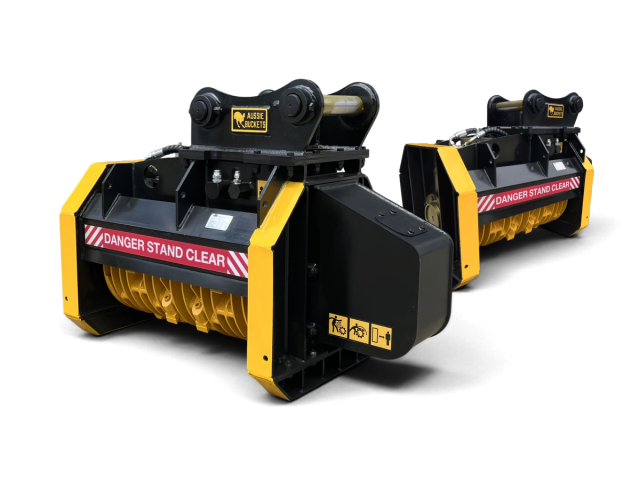
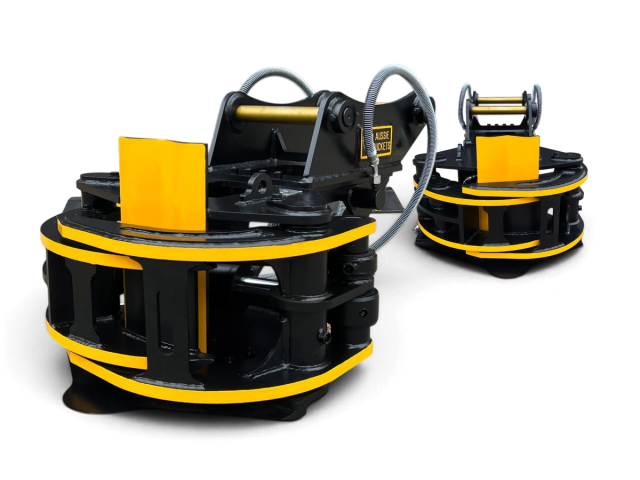
If the job is cutting grass, scrub and light regrowth, you want a flail mower. If the job is reducing standing timber, saplings, and stumps to chip, you want a mulcher. Both bolt onto the same boom and both leave vegetation on the ground behind them, which is where the confusion starts. What they do to that vegetation is vastly different, and so is what they ask of your machine.
Here's what the two heads share, how each one works, what each is built for, and how to match one to your excavator.
The short answer
| Attribute | Flail Mower | Mulcher |
|---|---|---|
| How it cuts | Hinged blades swing on a rotating shaft and cut through momentum | Fixed-tooth drum grinds material into chip |
| Built for | Grass, light scrub, roadside growth, regrowth on batters and drain lines | Standing scrub, saplings, stumps, and timber regrowth |
| Finish | Cut material left where it falls | Fine chip left on site, no carting |
| Max cutting diameter | 80 to 100 mm | 250 to 400 mm |
| Machine range | 2 to 30 tonne, four builds | 5 to 30 tonne, three builds |
| Hydraulic flow | 40 to 100 L/min | 60 to 240 L/min |
A simple rule of thumb: choose the flail mower where vegetation needs to be cut, and the mulcher where it needs to be reduced.
How an excavator flail mower works
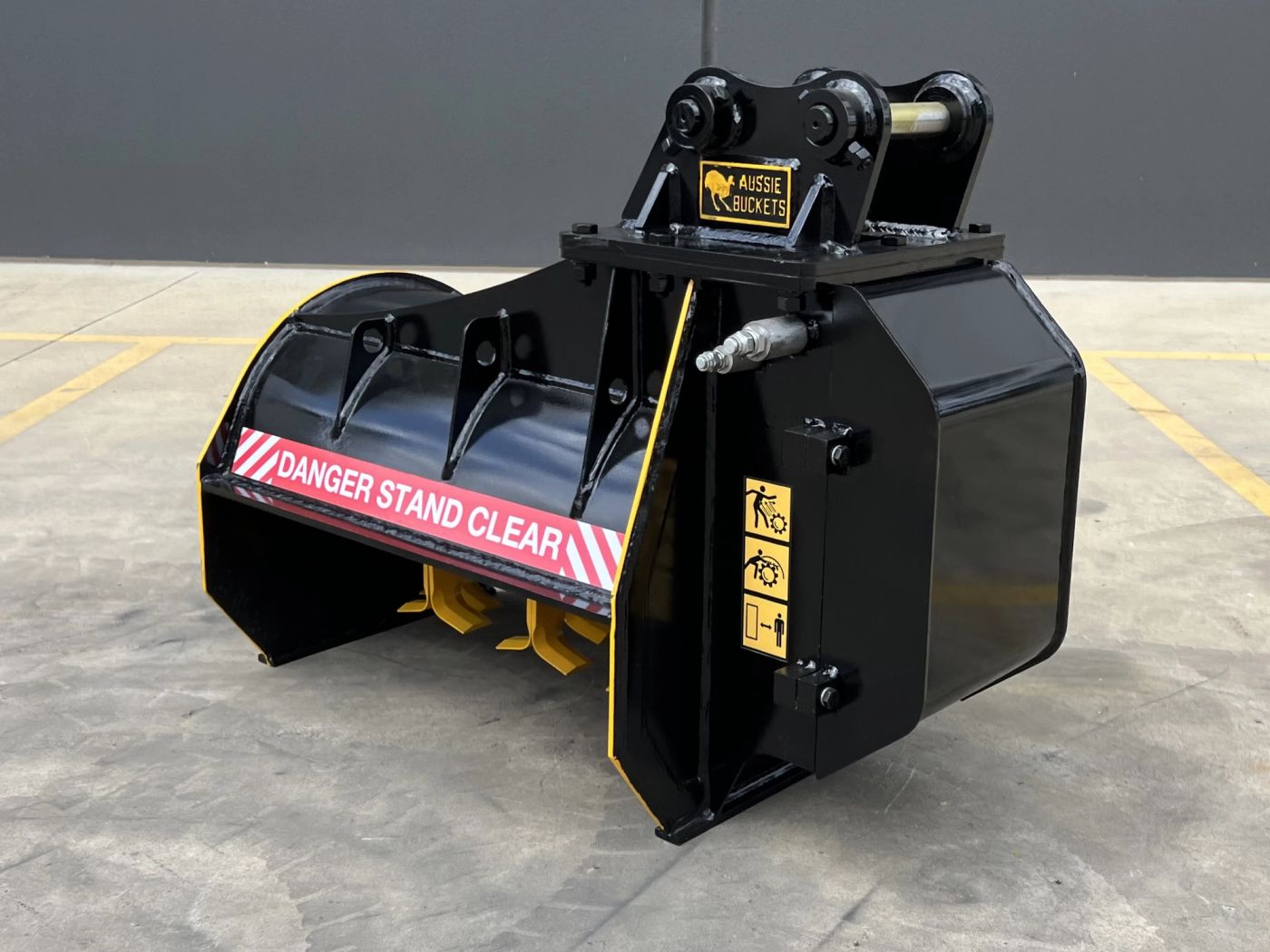
A flail mower carries rows of hinged blades on a rotating shaft. The blades swing out under centrifugal force and cut through whatever they hit. If they strike a rock or a post they fold back instead of snapping, which is why flail heads survive roadside work that would wreck a fixed blade.
The flail mower is the high-speed, lighter-duty head of the pair. It is built for vegetation management: getting through brush, grass, and lighter material quickly, rather than grinding through timber.
You get two blade profiles on the same head:
- Y-flail blades for long grass and light growth, where the job is closer to slashing.
- Hammer flails for chipping saplings, bushes, and woody regrowth up to 80 mm on the smaller builds and 100 mm on the 10 to 30 tonne builds.
Both types reverse for a second edge and replace when worn, so the same head can be re-specified for the season rather than the year. Roadside crews asked for exactly that: the one machine mows soft grass on Monday and clips regrowth on Thursday.
The real advantage over a tractor-mounted slasher is reach. The boom puts the head onto batters, table drains and steep verges while your machine stays on level ground. A slasher must sit on the slope it cuts, which limits how steep it can safely work. That covers most of the verge network in this country.
How an excavator mulcher works
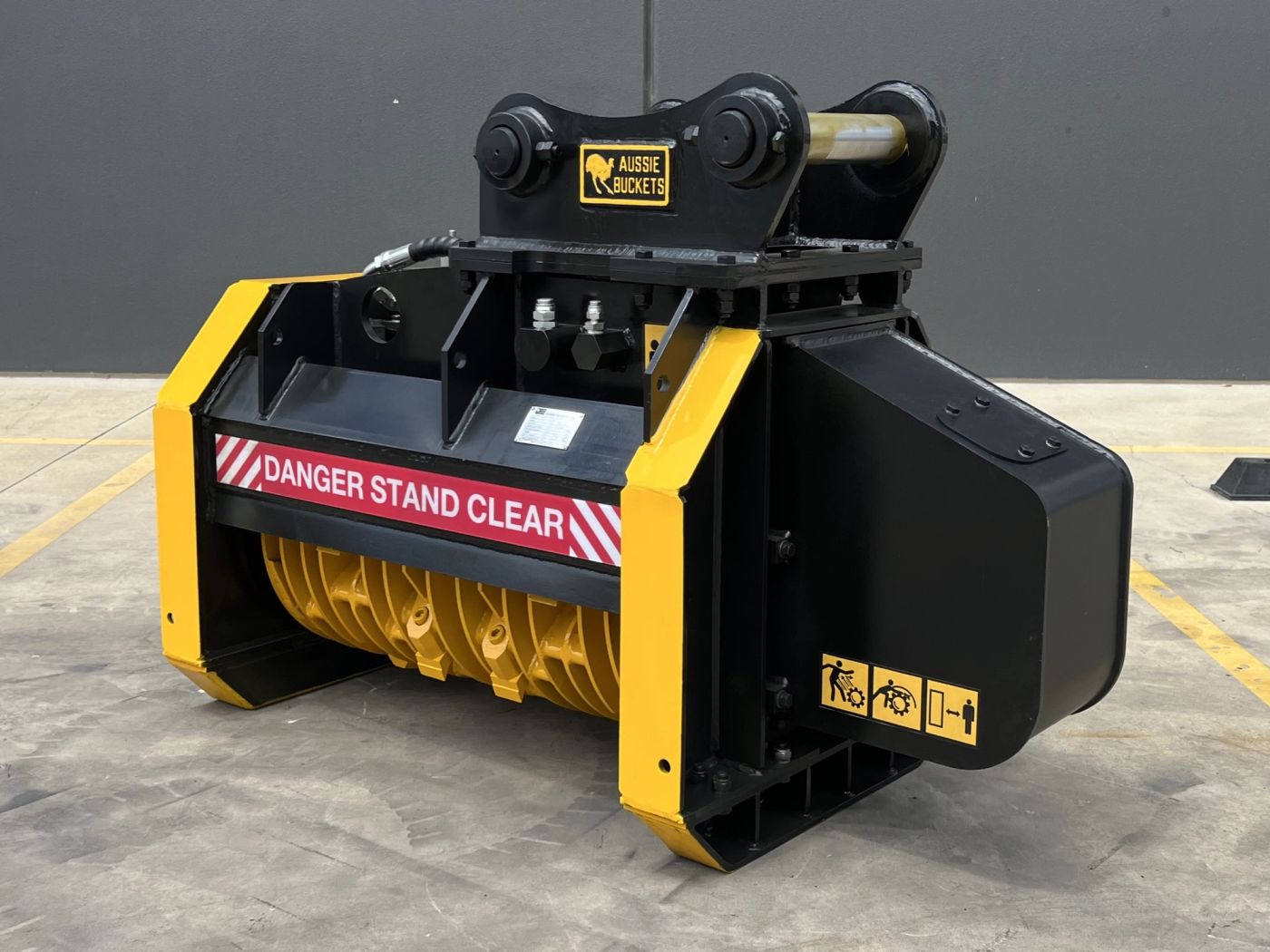
A mulcher runs a drum of fixed teeth at speed and grinds standing material down into chip rather than cutting it off. That is why it handles saplings, stumps and regrowth that would stop a flail head dead. The three Aussie Buckets builds cut up to 250, 300 and 400 mm diameter depending on the size of the head.
The part that matters most in dense Australian scrub is the bite limiter, a Hardox plate ahead of the rotor. It does two jobs. It shows you how far to push the head into the material, and it stops the rotor being buried so deep that it bogs down and loses performance. Contractors told us throughput, not raw power, was the number that counted. A head that takes too big a bite stalls, and every stall is a reversed boom and a lost minute. With the bite limiter the rotor keeps turning in heavy growth and leaves a finer finish behind it.
Between the motor and the rotor shaft sits a rubber coupling. A mulcher is more likely than a flail to get bogged on a large log or stump, and if the rotor stops dead the coupling absorbs that static load instead of passing it straight through to the motor.
A few other details that come from crews running these heads hard:
- NM500 skid plates take the contact wear, so the head can work at grade and below on soft ground without damaging the housing. That is what lets a mulcher grind stumps.
- Two reversible blade types: die steel for clearing work and high-speed operation, tungsten carbide for heavy logs and stumps. Both reverse for a second edge and replace when worn.
The chip stays on site. Nothing gets carted, burnt, or stockpiled, which on a clearing job is often the difference between a one-pass operation and a three-pass one.
What each one is built for
The two heads overlap less than people expect.
Reach for the flail mower when the job is maintenance. Roadside verges and medians. Fence lines and firebreaks that need keeping clear rather than clearing. Table drains and batters. Property grass and light regrowth. Anything where the growth is under about 100 mm and the goal is to cut it down and move on.
Reach for the mulcher when the job is clearing. Forestry regrowth and scrub up to 400 mm. Blocks needing clearing before earthworks. Powerline and pipeline corridors. Fuel reduction where woody material must be reduced, not just trimmed. Stump grinding after felling. Ground a tractor cannot get onto.
For forestry work specifically, the mulcher does the heavy lifting: taking standing regrowth and slash down to chip in one pass. The flail mower earns its place on the same job keeping tracks, firebreaks, and access corridors open once the heavy clearing is done.
Hydraulic flow matters more than machine weight
This is the part people get wrong most often. Both heads run off your auxiliary circuit, and flow decides which head your machine can drive. Machine weight only tells you which builds are physically a fit.
A flail mower is light on flow: 40 to 45 L/min on the 2 to 9 tonne builds, and 90 to 100 L/min on the 10 to 30 tonne builds. Most machines with a factory auxiliary circuit will run one.
A mulcher asks for more. The smallest build needs at least 60 L/min, and the largest runs up to 240 L/min at 245 bar. Run a mulcher below its rated flow and the rotor stalls in dense material no matter how big the carrier is. Two machines in the same weight class can deliver vastly different auxiliary flow, so check your circuit figures before you make a decision.
Flail Mower builds
| Machine | Cutting length | Max cutting diameter | Flow rate | Pressure | Weight |
|---|---|---|---|---|---|
| 2 to 4 tonne | 631 mm | 80 mm | 40 – 45 L/min | 180 bar | 270 kg |
| 5 to 9 tonne | 931 mm | 80 mm | 40 – 45 L/min | 200 bar | 350 kg |
| 10 to 16 tonne | 931 mm | 100 mm | 90 – 100 L/min | 250 bar | 500 kg |
| 17 to 30 tonne | 1,431 mm | 100 mm | 90 – 100 L/min | 250 bar | 650 kg |
Specifications as listed on the Flail Mower product page.
Mulcher builds
| Machine | Cutting length | Max cutting diameter | Flow rate | Pressure | Weight |
|---|---|---|---|---|---|
| 5 to 9 tonne | 668 mm | 250 mm | 60 – 150 L/min | 245 bar | 650 kg |
| 10 to 16 tonne | 905 mm | 300 mm | 90 – 150 L/min | 245 bar | 1,000 kg |
| 17 to 30 tonne | 1,303 mm | 400 mm | 140 – 240 L/min | 245 bar | 1,500 kg |
Specifications as listed on the Mulcher product page.
Can one attachment do both jobs?
Up to a point. A flail mower fitted with hammer flails will chip saplings and shrubs to 80 or 100 mm, which covers a lot of regrowth. A mulcher will cut grass, but it is a heavier head that costs more and needs more flow, so using it for mowing is the wrong tool for the hours.
The honest way to decide is to look at where most of your hours go:
- Mostly grass and light scrub with the odd sapling: flail mower with hammer flails. Keep a set of Y-flails for the soft work.
- Mostly woody regrowth, scrub, and stumps: mulcher. The flail will stall and you will spend the day backing off.
- Both, across the year: contractors doing forestry and roadside work often run both heads on the same carrier and swap for the season. One quick hitch, two attachments, no second machine.
Questions operators ask
Yes. The rotor cuts to ground level and below on soft ground, which handles stumps left after clearing. NM500 skid plates take the contact wear so the head can work at grade without damaging the housing, and the chip is left on site rather than carted.
Still unsure of your next purchase?
Not sure what size would be a fit for your machine, or what your auxiliary circuit delivers? Send us your machine make and model with the flow and pressure figures and we will match the head to the circuit before anything gets built.